News & Exhibitions

2.11.2023  News Jere Vainio and Kaija Hinkula to be awarded grants for alumni res­i­den­cies Jere Vainio and Kaija Hinkula, alumni of
Read more »
21.10-12.11.2023KCCC, Klaipeda, LithuaniaUnder Conditions / Henna Aho & Kaija Hinkulahttps://www.kkkc.lt/en/exhibitions/kaija-hinkula-and-henna-aho-duo-exhibition-under-conditions/ Under Conditions is a duo exhibition by contemporary artists artists
Read more »
28.7.29.7.2023 Salzburg Summer Academy, Hohensalzburg FortresJoining the group exhibition by artists by the workshop by Mette Sterre in the Fortress
Read more »
CORNER / Woikka Contemporary, Voikkaa FI3.7.-30.7.2023Kaija Hinkula's CORNER transforms Woikka Contemporary's window spaces into a colorful spatial intervention. Hinkula has
Read more »
Painting as a ball game, shopping cart, and vent pipe An essay by Helsinki-based art critic Eero Karjalainen (FI)Notes on
Read more »
26.5.-29.6.2023 Pragovka Gallery, Prague, CZ Kaija HinkulaBoulder StarPragovka Gallery26.5.-29.6.2023Kolbenova 923/34aPrague,CZOpening 25.5. 6 pm Kurátor a autor textu / Curator and
Read more »
Stargazer, my solo show in HAM Gallery Helsinki, featured in KubaParis blog : https://kubaparis.com/submission/284921
Read more »
14.1. - 26.2.2023 HAM Gallery, Helsinki Helsingin Sanomat 20.2.2022 https://www.hs.fi/kulttuuri/art-2000009335381.html EN The solo exhibition of Kaija Hinkula, Stargazer, in the HAM Gallery
Read more »
Zoning19.11.2022–22.1.2023Kristina BengtssonNiklas HallmanKaija HinkulaKevin MalcomIndefinite, without limit, forever.Määrittelemätön, rajaton, ikuinen. Lämpimästi tervetuloa näyttelyn avajaisiin perjantaina 18.11. klo 18–21!  Avajaisissa esiintyy gem-K.Näyttely
Read more »
RESIDENCY NEWS / ISCP New York

RESIDENCY NEWS / ISCP New York

2.11.2023  News

Jere Vainio and Kaija Hinkula to be awarded grants for alumni res­i­den­cies

Jere Vainio and Kaija Hinkula, alumni of Uniarts Helsinki’s Academy of Fine Arts, have been selected to participate in alumni residencies in Scotland and New York. Vainio was selected for a four-month residency taking place in Scotland next year, while Hinkula’s six-month residency in New York will begin in January 2025. The Academy of Fine Arts residency programmes for alumni are part of a collaborative project between the Academy of Fine Arts and the Saastamoinen Foundation.

The goal of the Ecologies in the Making: Sculpting Futures residency in Scotland is to support visual artists in studying and developing ecological methods and contexts for their artistic practice. The International Studio & Curatorial Program (ISCP), on the other hand, is New York’s most comprehensive international visual arts residency programme.

The application period for the alumni residencies was 1-30 September 2023. An international jury of experts pre-selected the grant applicants, based on which the residency centres made the final decision. Below you can read excerpts from the jury’s reasoning for selecting the two grant recipients.

The academy’s other residency partners include Jan van Eyck Academie in Maastricht, LIFT Liaison of Independent Filmmakers of Toronto and SPACE in London. The application period for these residencies will begin in February 2024. The application period for the Rijksakademie van beeldende kunsten residency will begin in September.

The Academy of Fine Arts and Saastamoinen Foundation extend their congratulations to the grant recipients!

An excerpt from the jury’s reasoning: Kaija Hinkula

The artist was seen to employ humour and playfulness in her deconstruction of painting, and to create a very strong presentation of her work in the application. There was respect for the time-based aspect of the work, and its ephemerality.

Jury panel:

  • Stig Baumgartner, University Lecturer, Uniarts Helsinki´s Academy of Fine Arts
  • Curator Aveline de Bruin, Curator
  • Susan Hapgood, Director ISCP

https://www.uniarts.fi/en/articles/news/jere-vainio-and-kaija-hinkula-to-be-awarded-grants-for-alumni-residencies/

UNDER CONDITIONS / KCCC, Lithuania

UNDER CONDITIONS / KCCC, Lithuania

21.10-12.11.2023
KCCC, Klaipeda, Lithuania
Under Conditions / Henna Aho & Kaija Hinkula

https://www.kkkc.lt/en/exhibitions/kaija-hinkula-and-henna-aho-duo-exhibition-under-conditions/

Under Conditions is a duo exhibition by contemporary artists artists Henna Aho & Kaija
Hinkula. Aho and Hinkula examine painting, its new forms and possibilities in the 2020s – the
boundaries, spatiality, materiality, the relationship to one’s own history and to the
surrounding reality. The works that freely stretch the traditional form of a painting comment
on the surrounding world, creating a space, where craftsmanship and every day life and utopia

combine into a process-like whole in the context of extended painting

On the almost-apparent paintings of Henna Aho and Kaija Hinkula

Painting as a medium carries a heavy history with itself. As the most studied but also the most
sold – and probably most produced – art form, a burden, according to many artists and art
historians, has cast itself on the medium. How can one say anything about painting, if so
much has already been made and stated? It is safe to say that painting has reached a kind of
oxymoron: it’s role in museums and text-book examples is solid, but in the infrastructures of
contemporary art it is not always taken as given – it is not too visible. The paradox lies in this
notion of visibility since a change in the reception of painting has become apparent, having
time to spread its roots. It is not, anymore, interesting to recognize something as a painting;
the focus has rather shifted to the medium as an area of artistic operation.

Above stated is the main historical and methodological frame in which Henna Aho’s and
Kaija Hinkula’s new duo exhibition Under the Conditions at KCCC settles. It also the only
settling that takes place in the exhibition, which is constantly in movement. Comprised of new
works from both painters, the movement could be described as a kind of double-
choreography: that of the artists with the space, and of the visitor in the space. This is not to
emphasize a sense theatricality, but to point to the stage-like essence in the way the exhibition
is constructed. There is an active relation to this world in the exhibition, but it operates like a
game with its own set of rules.

What could be the rules, then? The space is the first dimension – concretely and conceptually
– to consider. Tactful and precise attitude towards an exhibition space has been important for
both Aho and Hinkula in their practices and previous exhibitions, but in Under the Conditions
a notion of site-specificity is taken further. The space, as the artists have stated, is the third
agency participating in making the exhibition, and spatial intervention is the main starting
point for Aho and Hinkula. It is still not meaningful to place the works in this exhibition to a
certain category of site-specific art, since different categories of site-specificity –
phenomenological, discursive, or institutional, to name a few – are constantly getting mixed
and blurred. I would rather speak of performative site- and situation-specificity, where
performativity points to a number of directions: conceptualizing the exhibition, building it

with in part materials found in the location, or visitors engaging with the works. Could even
this text be seen as an extension for the question of what site-specific painting is?

The artists engage with the space through the artworks in a multitude of ways. After thinking
about the space, the urgent question, arising from the title of the exhibition, is that of what are
the conditions under which the artists operate. Aho and Hinkula have both experimented at
the borders of painting (un)systematically – one should not argue that they stretch the borders,
since the borders know no limits. For example, ready-made objects, which are a seminal part
of the artists working habitudes, are re-contextualized in the works. This happens by
relocating the ready-made objects to the area of painting, but without them losing their
relation to everyday realm. The usage of ready-made objects in the paintings is taken so far
that it is not clear where the work starts and where it ends. Is the monitor presenting a video
work physically essential part of the work? Or the heater, around which a site-specific
painting is built? In the exhibition even painted colors have a ready-made -character to them,
as they are chosen by color code rather than by mixing or experimenting. The burdensome
history of painting is thus faded, only to emphasize the fact that it is first and foremost
painting that is being considered here.

Still, there is nothing mystical in Under the Conditions. The references to this world are so
direct that it is actually difficult to name them as just references. The works in the exhibition
approach painting as a medium in painterly conditions. The rules applied are, thus, strict and
loose at the same time: working-in and thinking-with painting, moving as far and as close as
possible, and preferably at the same time.

Text by Eero Karjalainen (FI)

CORNER / Woikka Contemporary

CORNER / Woikka Contemporary

CORNER / Woikka Contemporary, Voikkaa FI
3.7.-30.7.2023

Kaija Hinkula’s CORNER transforms Woikka Contemporary’s window spaces into a colorful spatial intervention. Hinkula has covered the windows with fabrics that form a color composition in the corner of the lower floor of the apartment building, creating a contrast with the inhabited landscape. Even though CORNER takes place in the exhibition space, it is tied to the public space and its life. A colorful observation in a familiar environment invites the passer-by to dream in the middle of the day

Kaija Hinkula (b.1984) is a visual artist who explores the possibilities and limits of painting. Hinkula graduated as a visual artist from Saimaa Academy of Arts and Master of Arts from the Painting Department of the Academy of Fine Arts. Her work is placed in the context of extended painting, where two-dimensional painting expands into a sculptural and spatial experience, combining e.g. to the methods of sculpture and time and space art

https://www.facebook.com/woikkacontemporary/

Painting as a ball game, shopping cart, and vent pipe / ESSAY by Eero Karjalainen

Painting as a ball game, shopping cart, and vent pipe / ESSAY by Eero Karjalainen


Painting as a ball game, shopping cart, and vent pipe

An essay by Helsinki-based art critic Eero Karjalainen (FI)

Notes on the fun of space and place in the paintings of Elina Autio, Kaija Hinkula, and Lasse Juuti

For the last two and a half years, I have more or less actively thought about humour in the paintings of Elina Autio, Kaija Hinkula, and Lasse Juuti. The artistic practices of the three Finnish painters have never really left my mind; whenever I think about contemporary painting, I remember the joyous strategies with which Autio, Hinkula, and Juuti approach the inevitable problems of working in the field called painting. For me, paintings, or painterly objects-in-space, by Autio, Hinkula, and Juuti articulate a nonchalant yet earnest relation to the sometimes-insurmountable history of (especially western) painting.

The three artists dealt with here seem to represent an important set of routes as an answer to an argument posed by many critics and theoreticians (following Eugène Delacroix), namely that what has already been said about painting is not enough. This assertion points to the fact that even though so much has been said and written about painting within art history and theory, it still seems that there are problems or questions – both theoretical and technical – about painting as a medium in an unsolved state.

These three painters work with different concepts and ideas, yet elements of humour connect their work. Their work is often also characterised in writing as “funny” or “witty”. That is also where my eagerness toward Autio, Hinkula, and Juuti spans from. What is their relation to painting, and why – not forgetting how – is this relation funny?

Different materials, different discourses

Walking in a gallery space, one encounters a setting that reminds of a post-storm view. A turquoise shopping cart on its nose; banana peel and face mask thrown around and landed on a purple canvas; even a fire hose in a messy pile. Spending a summer day in the architecturally interesting Meri-Rastila, one notices two colourful anomalies in the somewhat grey surroundings: round-shaped canvases filling two formal openings on the façade of an apartment building. “This is painting” is hardly the first note one makes.

Kaija Hinkula is an artist who comments serious, formalist questions about painting with holistic fun from beginning to end: sometimes the most serious questions can best be addressed with humour. Her work is characterised by the usage of ready-made objects, a plastic finish, and site-specificity, amongst others. Her work plays with the idea that painting has to, in one way or another, behave like a painting to be considered as such. Hinkula’s exhibitions and installations, such as the ones described above in Forum Box (2021) and Pori Biennale (2022), take up many strategies from language. The work is motivated by discursive intentions rather than focusing on things such as surfaces or even paint.

Hinkula’s work has often been characterised as being in and defined by the ‘expanded field’ of painting – for example, as something moving between painting and sculpture. Not disagreeing with this, I would go further and highlight the painterly components and propose that Hinkula’s practice moves medium-specifically in the field of painting. She does this first and foremost through the act of deconstructing the traditional elements of painting and presenting them in new, context-sensitive ways – be it public intervention or site-specific installation. Her work always seems to offer a whole idea rather than exhibiting specific or small details. It is not to say that what we see in her works is random; on the contrary: the assemblages are carefully constructed. The painterly praxis of Hinkula presents new possibilities to react to painting as a moving, happy medium. When one places her work in the field of painting, and the everyday mess gets mixed with careful constructions of discourse, the reaction is like the best of jokes – taking its time but ending up with a deep laugh.

If one thinks about paintings where the setting is flipped – where laughter precedes contemplation – the work of Lasse Juuti comes quickly to mind. Juuti’s paintings have been gradually coming off the wall only to end up back on it again – or even becoming the wall itself, as in his installation at Mänttä Art Festival (2022). In his practice, Juuti uses contradictory and indefinite objects and large forms and shapes to activate the viewer, both bodily and intellectually, in this order. There is an exhilarating sensation of childlike awe when one is in the space with Juuti’s work. Finding familiar objects or realising that something actually belongs to the work itself is part of a language of painting that builds primarily on the materiality of the components. For example, the ready-made objects used – takeaway coffee cups (a recurring theme) or table tennis balls – gather new meanings for their context is so radically altered.

At first, it seems his paintings have an unclear nature, but by building his own world through the lack of sharp clarity, Juuti operates via a unique and self-sustaining language. Juuti’s paintings look as if they are made by hand without too much attention to minimal details, thus actively joking about the manly tradition of big paintings in an exhibition space. Still, there is not a lack of colour or experimentation of shape. There is a character of fooling or gaming in the work. That is visible in many of Juuti’s paintings, for example, in Collector’s Green (2021), a large painting depicting a distorted tennis field or pool table, sports associated with a certain grandeur. The work, presented in Helsinki Contemporary in 2021, reacts to both the gallery and the exhibition’s viewers in a harmless, laughable way. Collector’s Green aptly shows how Juuti works with materials in a way where the painted canvas is always present but always shaped anew, associated and connected with something that can’t quite be put into language. Like Hinkula, Juuti’s work also has a discursiveness to it. It builds on a tension between the materiality of canvas and paint – always moving towards the conceptualisation of painting but never reaching, or even trying to reach, it.

If Hinkula’s humour relies on discourse and Juuti’s on materiality, Elina Autio is an artist whose work is located somewhere in the middle. An interplay of colour, form – mainly by modified and shaped stretchers – and ways of mounting, Autio’s work activates the viewer to think about what a painting is and how it can be defined. Through minor, subtle gestures, Autio turns the accustomed viewing situation into a new position and builds restrictedly on the moment of watching. For the last few years, Autio has worked with traditional qualities of presenting painting; when the work – the singular painting – is not hung on the wall, it usually rests against it. She has also repeatedly researched the use of colour and angular shape of painting, as in the works seen in Kunsthalle Helsinki (2019) or tm·gallery (2021). In both exhibitions mentioned, a gesture of transition was present, from one architectural space to another, from inside to outside.

Autio moves in the field of historical painterly narratives, commenting abstraction and colour theories. In her earlier work, such as Pipework (2013), seen in the exhibition Elements (2015) at the Museum of Contemporary Art Kiasma, a reference to building infrastructures is also present, as in the later work, but in a more concrete way. The mentioned work consists of spray-painted cardboard-made ventilation pipes, provoking the viewer to pose questions about the placement of these components in buildings and architectural environments. The transitional nature of the work is present in the movement between a building and the idea of a building. Besides this, the work also has a suspending quality, encouraging the viewer to stop and look.

Autio can be seen as organising a play where the viewer needs to actively move from looking at the painting in a traditional manner to examining the materials and connecting all of this to the surroundings – both the actual space and the space of painting as a medium.

Endnote: painting is free

Looking at Finnish painting of the 21st century, one notices that the boundaries of painting have become counter-restrictive. So much about painting has already been said that a space of freedom has made itself apparent. This is exactly where Autio, Hinkula, and Juuti work – by moving actively between questions about painting as a medium and a space of having fun. The argument seems blunt at first but in the sphere of contemporary painting it appears radical: the painting itself seems free. The humorous nature in the work is essentially connected to the medium of painting through the implementation of ironic, affective, and colourful strategies.

htttp://www.finnishpainters.fi/karjalainen-finnish-painters/

BOULDER STAR / Pragovka Gallery

BOULDER STAR / Pragovka Gallery

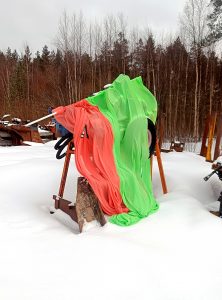
26.5.-29.6.2023 Pragovka Gallery, Prague, CZ

Kaija Hinkula
Boulder Star

Pragovka Gallery
26.5.-29.6.2023
Kolbenova 923/34a
Prague,CZ
Opening 25.5. 6 pm

Kurátor a autor textu / Curator and author of the text: Kristýna Řeháčková
Překlad / Translation: Eva Galovičová Dubová

Finnish artist Kaija Hinkula let the audience enter a new world: utopian visions inspired by a disappearing underwater universe.

The inspiration for the site-specific installation Boulder Star made for the Pragovka Gallery was the artist’s own fantasy
world, created in her head in her studio. By bringing the installation in the gallery, the piece takes on its final form becoming
a space for the play and imagination of the audience. In her own words, Hinkula gives the audience a manual for modelling and
understanding a new universe, according to which their own world may or may not arise.

Kaija Hinkula’s artistic work includes the expanded painting, where a spatial intervention is created with the distinctive qualities of painting such as color and composition. She explores the spatiality of painting and its expanded materiality. According to artist and art theorist Mark Titmarsch, expanded painting can be viewed as a free game with painting inspired by Austrian philosopher Ludwig Wittgenstein
and his notion of a game. While Wittgenstein considers speech a game, Titmarsch applies this principle to painting. Just like
the free play is allowed in tennis despite the rules given, the basic set of conditions that determine a painting can be deliberately
omitted, and in contrast other elements, such as videos, fabrics, threads, ceramic objects, colored plates and other materials
can be added.

Formally, references to the minimalism of 1960’s can be traced in Hinkula’s work. However, the austerity and restraint
associated with minimalism is absent in her work which can be labeled as fantastic minimalism in the author’s own words. The
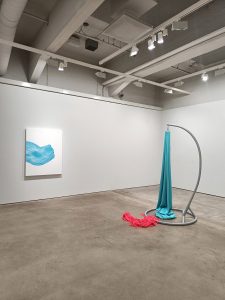
term was coined with some exaggeration while preparing for her previous installation Stargazer in the HAM Gallery, Helsinki, with
art historian Juha-Heikki Tihinen to describe her current work. Although she is minimalist in the use of monochromatic colour tones
and discipline of a form, Hinkula’s work is also playful, colourful, fantastical and organic in its shapes.

The world presented here feels organic, inviting the viewer into the sea to watch the coral reefs. In English, Boulder Star refers to an endangered species of coral. The created environment is a visual inspiration for the artist’s utopian visions in the first place, nevertheless, environmental aspects of her work emerge too, as she creates a fantasy world out of items that may soon no longer be part of the world as we know it today.

Hinkula’s work is also characterized by recycling and repetition of elements, materials and colors. The finalization of
the work took place directly in the gallery where individual elements acquired new connotations and meanings both from the
artist’s and from the viewer’s perspectives. The created worlds allude to Hinkula’s previous installations, which this exhibition follows up on bringing the installation to other levels.

Kaija Hinkula (b. 1984) holds a master’s degree in painting from the Academy of Fine Arts in Helsinki and the Saimaa University of Applied Sciences in Finland. Her works are represented in the collections of the Helsinki Art Museum(HAM), Oulu Art Museum and The Finish
State Art Collection.


https://www.facebook.com/pragovkagallery/

STARGAZER / HAM Gallery

STARGAZER / HAM Gallery

14.1. – 26.2.2023 HAM Gallery, Helsinki

Helsingin Sanomat 20.2.2022

https://www.hs.fi/kulttuuri/art-2000009335381.html

EN

The solo exhibition of Kaija Hinkula, Stargazer, in the HAM Gallery presents new sides of the artist’s boundary-breaking expression.

In recent years, Kaija Hinkula has repeatedly expanded the possibilities of painting by creating works that could be seen as spatial interventions, such as those presented in Forum Box (2021) or the Oulu Museum Of Art (2022). In these both, the artist created a reinterpretation of the exhibition space with her installations. Hinkula can also surprise the audience, for example by bringing the aesthetics of construction site into the gallery room, as in Gallery Harmaja in Oulu in 2019. Hinkula’s newest exhibition, Stargazer, remains within the HAM Gallery, but now she will recreate the painting object.

The works exhibited in Stargazer are, in the artist’s own words, ‘modelling manuals for a new universe’. The artist has also described her previous artistic vision by stating that ‘my works are centred around displacing a place, an observation or a material from its context and transforming it into a new shape, space and action.’ But what does this mean in practice? In her new works, the artist has laser-cut holes in a painting canvas. The works may feature fake braids or thread as well as ceramic miniature sculptures hanging from the canvas. Hinkula’s exhibition will reach its final form in the gallery space as the works are hung, but the space will feature works of different kinds, moving somewhere between paintings and sculptures, which could be described by using the artist’s own expression, fantastic minimalism.

What is fantastic minimalism? It is – naturally – imaginative and colourful, but it can be just as well characterised by minimalistic monochrome tones and disciplined language of form. Hinkula blends different worlds together in uninhibited ways creating playfull fantasies, so the severity or restraint often linked to minimalism is not present here. Readymade and handmade as well as two-dimensional and three-dimensional are both contradictions that the artist combines together one work at a time. This time, spatiality is present inside the paintings, where audience can peek into, thanks to the holes cut in the surface. On one hand, Hinkula’s works bring to mind parallels to cubistic ideas or Brazilian concretism of the 1910s, but they also seem to fit well in this time and place while also reaching towards the future sci-fi aesthetics.

Hinkula’s material world is opulent, as she supplements the traditional painting pigments with a wide range of other materials. In the works of Stargazer, she has also used MDF, alkyds, spray paint, fabric, nylon, polyester thread, ceramics, a globe and metal pipes. Recently, the artist has also become interested in moving pictures, which will open up new possibilities for her in the future. Hinkula’s work process is characterised by multi-temporality and multi-materiality, which she applies to explore the possibilities offered by different forms of work or their different presentation methods. Or, as the artist herself expresses her current way of thinking: ‘I have been thinking about futures. I have been thinking about new logics – and methods for a circle.’

When the artist asks if it would be possible to imagine alternative realities and word orders, the answer is yes. And she proves this through her works and exhibitions, showing how art is always a form or dissidence and rethinking. Hinkula takes her audience into an experience that reveals surprising directions and views. She does not offer a static style or expression, but rather shows the fantasty-like views born in her studio. Hinkula’s workspace does not have a chair, because the artist never remains still and is always in motion. The same applies to her art, described as ‘malleable geometry’ or a ‘place between realities’. Stargazer à la Kaija Hinkula takes the viewer to galaxies far, far away, simply by sight. This, if anything, is fantastic minimalism.

Text: Ph.D. Juha-Heikki Tihinen

Kaija Hinkula (born 1984) has graduated as a visual artist from the Saimaa University of Applied Sciences and as Master of Arts in the subject area of Painting from the Academy of Fine Arts. Her artistic work takes place in the field of expanded painting, where two-dimensional paintings expand into sculptural and spatial experience, combining methods of fields such as sculpture and time and space arts.

FI

Kaija Hinkulan yksityisnäyttely Stargazer HAM-galleriassa esittelee uusia puolia taiteilijan raja-aitoja ylittävästä ilmaisusta.

Kaija Hinkula on viime vuosina toistuvasti laventanut laajennetun maalauksen mahdollisuuksia luomalla kokonaisuuksia, jotka voivat olla tilallisia interventioita, kuten hän teki Forum Boxissa (2021) tai Oulun taidemuseossa (2022). Molemmissa taiteilija loi näyttelytilan uudelleentulkinnan installaatioillaan. Hinkula voi myös yllättää ja tuoda esimerkiksi rakennustyömaan estetiikan galleriatilaan, minkä hän toteutti Oulussa Galleria Harmajassa vuonna 2019. Hinkulan uusin näyttely Stargazer pysyttelee HAM-galleriassa, mutta hän muokkaa nyt maalausobjektin uuteen uskoon.

Stargazerin teokset ovat taiteilijan omin sanoin ”mallinnusohjeita uudelle universumille”. Hän on kuvannut aikaisempaa taiteellista linjaansa: ”Teosteni keskiössä on paikan, havainnon tai materiaalin siirtäminen kontekstistaan ja sen muuntaminen uudeksi muodoksi, tilaksi ja toiminnaksi.” Mutta mitä tämä on käytännössä? Uusissa teoksissaan taiteilija on leikannut laserilla aukkoja maalauspohjaan, joka voi olla varustettu tekoletillä tai maalauspohjasta riippuu lankoja ja siihen on kiinnitetty keraaminen pienoisveistos. Hinkulan näyttely muotoutuu lopulliseen asuunsa galleriatilassa ripustuksen myötä, mutta siellä tulee olemaan erilaisia teoksia, jotka liikkuvat maalauksien ja veistosten välissä ja joita voisi kuvata taiteilijan omalla ilmaisulla fantastinen minimalismi.

Mitä fantastinen minimalismi on? Se on tietysti mielikuvituksellista ja värikylläistä, mutta sitä luonnehtii yhtä hyvin minimalistinen yksivärisyys ja kurinalainen muotokieli. Hinkula sekoittaa vapautuneesti erilaisia maailmoita, ja luo leikkisiä fantasioita, mutta toteuttaa ne minimalistisesti. Tämä tarkoittaa, ettei minimalismiin usein yhdistetty vakavuus tai pidättyväisyys kuuluu tähän yhteyteen. Readymade ja käsintehty sekä kaksi- ja kolmiulotteinen ovat molemmat vastakohtapareja, joita taiteilija yhdistelee teos kerrallaan. Tilallisuus löytyy tällä kertaa maalausten sisältä, jonne katsoja näkyy pinnan aukotuksen ansiosta. Hinkulan teokset tuovat mieleen toisaalta taidehistoriallisia paralleeleja 1910-luvun kubistien ideoista tai brasilialaisesta konkretismista, mutta ne tuntuvat myös olevan kotonaan tässä ajassa ja paikassa, ja kurkottavan myös tulevaan scifi-estetiikassaan.

Hinkulan materiaalinen maailma on yltäkylläinen, sillä hän tuo perinteisten maalauspigmenttien rinnalle myös kaikkea muuta. Stargazerin teoksissa hän on käyttänyt seuraavia materiaaleja: mdf, alkydi, spray, kangas, nylon, polyesterilanka, keramiikka, karttapallo, metalliputket. Taiteilija on myös viime aikoina ollut kiinnostunut liikkuvasta kuvasta, mikä avaa hänelle uusia mahdollisuuksia tulevaisuudessa. Hinkulan työskentelyä luonnehtii moniaikaisuus ja -materiaalisuus, jolla hän tutkii erilaisten teosmuotojen ja niiden esittämistapojen tarjoamia mahdollisuuksia. Tai, kuten taiteilija itse ilmaisee tämänhetkistä ajatteluaan: ”Olen miettinyt tulevaisuuksia. Olen miettinyt uutta logiikkaa – ja tapoja ympyrälle.”

Kun taiteilija kysyy ”olisiko mahdollista kuvitella vaihtoehtoisia todellisuuksia ja maailmanjärjestyksiä”, on vastaus kyllä. Tämän hän osoittaa teostensa ja näyttelykokonaisuuksiensa keinoin, miten taide on aina toisin- ja uudelleenajattelua. Hinkula vie katsojansa kokemukseen, joka avautuu yllättäviin suuntiin ja näkymiin. Hän ei tarjoa staattista tyyliä tai ilmaisua, vaan esittelee työhuoneellaan syntyneitä huimia näkyjä. Hinkulan työhuoneella ei ole tuolia, koska taiteilija ei pysy paikoillaan, vaan on koko ajan liikkeessä. Sama pätee hänen taiteeseensa, joka on kuin ”taipuisaa geometriaa” tai ”paikka todellisuuksien välissä”. Stargazer Kaija Hinkulan tapaan vie katsojan kaukaisiin galakseihin katsomalla. Tämä jos mikä on fantastista minimalismia.

Teksti: FT Juha-Heikki Tihinen

Kaija Hinkula (s.1984) on valmistunut kuvataiteilijaksi Saimaan AMK:sta sekä taiteen maisteriksi Taideyliopiston Kuvataideakatemian maalauksen osastolta. Hänen työskentelynsä sijoittuu laajennetun maalauksen kontekstiin, jossa kaksiulotteinen maalaus laajenee veistokselliseksi ja tilalliseksi kokemukseksi yhdistyen mm. kuvanveiston ja tila-aikataiteen menetelmiin.

ZONING / Sic

ZONING / Sic

Zoning
19.11.2022
22.1.2023

Kristina Bengtsson
Niklas Hallman
Kaija Hinkula
Kevin Malcom

Indefinite, without limit, forever.
Määrittelemätön, rajaton, ikuinen.


Lämpimästi tervetuloa näyttelyn avajaisiin perjantaina 18.11. klo 18–21!  
Avajaisissa esiintyy gem-K.
Näyttely on avoinna 18.11.2022–22.1.2023 (suljettu välillä 19.12.–11.1.)

You are warmly welcome to the opening of the exhibition on Friday 18th November at 18:00–21:00!
gem-K will perform at the opening.
The exhibition will be open 18.11.2022–22.1.2023 (closed in between 19.12.–11.1.)

Kuva/image: Kristina Bengtsson


Aukioloajat ja saapuminen:

Malmin vanha asemarakennus, 00700 Helsinki

Aukioloajat
torstai–perjantai: 14–18 
lauantai–sunnuntai: 12–16

Saapumisohjeet Malmin vanhaan asemarakennukseen
Julkinen liikenne Malmin asemalle, uloskäynti Kirkonkyläntien puolelta
SIC sijaitsee tien toisella puolella bussipysäkin H3563 takana

Esteettömyys
SICiin on esteetön kulku gallerian pääovesta. Junalaiturin eteläpäädystä kulkee hissi gallerian eteen. WC ei ole tarpeeksi tilava täyttääkseen esteettömyysvaatimuksia.

Visitor information:

Malmi Old Station, 00700 Helsinki

Opening hours
Thursday–Friday: 14–18 
Saturday–Sunday: 12–16

Arrival at Malmi Old Station
Public transport to Malmi station, exit from Kirkonkyläntie
SIC is located across the road behind bus stop H3563

Accessibility
SIC is accessible through the main entrance. There is an elevator access at the southern end of the train platform. The toilet is not spacious enough to meet accessibility standards.


SIC
Malmi Old Station
Vanha Helsingintie 24
00700 Helsinki